If you are preparing for the PMP certification right now, you have probably noticed one question coming up everywhere: What exactly changed between the new PMP 2026 vs old PMP?
It is a fair question, and an important one. PMI officially retiring the 2021 Examination Content Outline (ECO) on July 8, 2026. Starting July 9, 2026, every PMP candidate sits the new exam. Whether you are just starting your prep or adjusting a study plan you already built, understanding the differences is not optional, it is the foundation of getting your preparation right.
This article gives you a complete, side-by-side breakdown of every meaningful difference between the old PMP exam (ECO 2021) and the new PMP 2026 (ECO 2026). No fluff, just the facts you need.
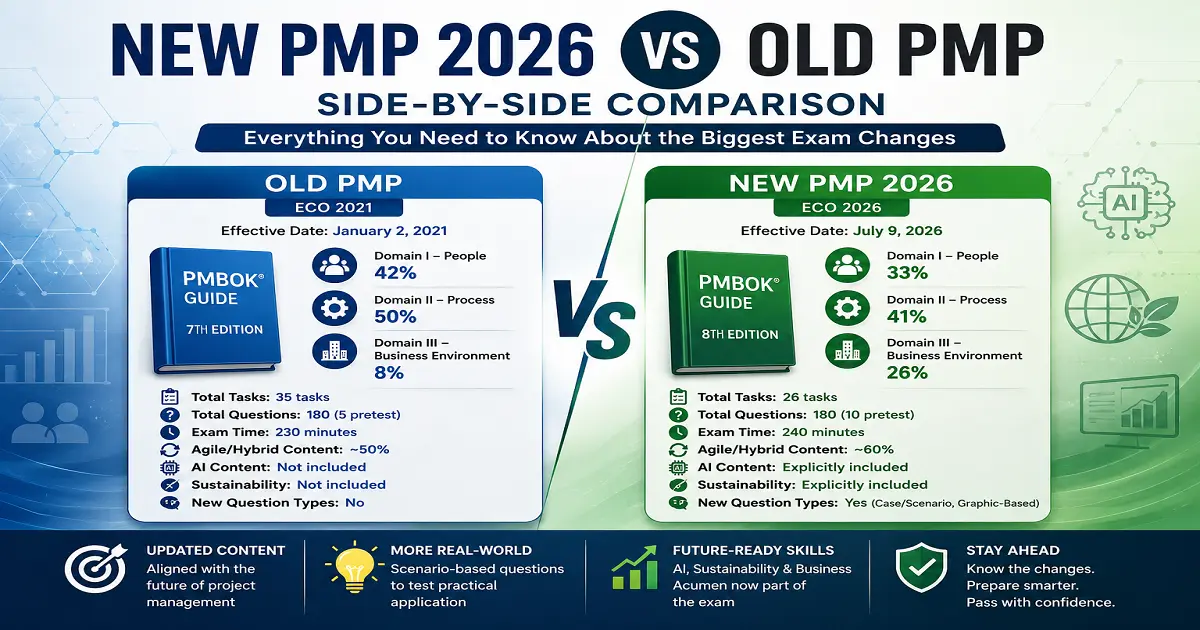
New PMP 2026 vs Old PMP: Side-by-Side Comparison
1. Quick Summary: The Biggest Changes at a Glance
Before diving into the details, here is a high-level summary of everything that changed:
| Category | Old PMP (ECO 2021) | New PMP 2026 (ECO 2026) |
|---|---|---|
| Effective Date | January 2, 2021 | July 9, 2026 |
| PMBOK Edition | 7th Edition | 8th Edition |
| Domain I — People | 42% | 33% |
| Domain II — Process | 50% | 41% |
| Domain III — Business Environment | 8% | 26% |
| Total Tasks | 35 tasks | 26 tasks |
| Total Questions | 180 (5 pretest) | 180 (10 pretest) |
| Exam Time | 230 minutes | 240 minutes |
| Agile/Hybrid Content | ~50% | ~60% |
| AI Content | Not included | Explicitly included |
| Sustainability | Not included | Explicitly included |
| New Question Types | No | Yes (Case/Scenario, Graphic-Based) |
Now let us go through each of these in detail.
2. Domain Weights: The Most Important Shift
The single biggest change between the old PMP exam and the new PMP 2026 is how PMI weights the three domains. The domain names stayed the same: People, Process, and Business Environment, but the percentages shifted dramatically.
Old PMP Domain Weights (ECO 2021)
| Domain | Weight | Approx. Questions (out of 180) |
|---|---|---|
| Domain I — People | 42% | ~76 questions |
| Domain II — Process | 50% | ~90 questions |
| Domain III — Business Environment | 8% | ~14 questions |
New PMP 2026 Domain Weights (ECO 2026)
| Domain | Weight | Approx. Questions (out of 180) |
|---|---|---|
| Domain I — People | 33% | ~59 questions |
| Domain II — Process | 41% | ~74 questions |
| Domain III — Business Environment | 26% | ~47 questions |
What This Means for Candidates
The headline change is Business Environment tripling from 8% to 26%. Under the old exam, a candidate could essentially skim the Business Environment domain and still pass comfortably. That strategy will fail on the new exam. With 26% weight, Business Environment now carries more exam questions than the old People domain did.
The Process domain remains the largest at 41%, but it dropped significantly from 50%. The People domain also shrank from 42% to 33%. The practical implication: if you studied primarily for the old exam using legacy materials, you may be significantly under-prepared for Business Environment topics like project governance, compliance, risk management, organizational change, and sustainability.
Study implication: Treat Business Environment like a major domain, not an afterthought. It now accounts for roughly one in every four questions on the exam.
3. Task Count: Fewer Tasks, Broader Scope
One of the structural changes that candidates often miss is the reduction in total tasks across all three domains.
| Old ECO (2021) | New ECO (2026) | |
|---|---|---|
| Domain I — People Tasks | 14 tasks | 8 tasks |
| Domain II — Process Tasks | 17 tasks | 10 tasks |
| Domain III — Business Environment Tasks | 4 tasks | 8 tasks |
| Total Tasks | 35 tasks | 26 tasks |
The task count went down from 35 to 26 overall, but this does not mean the exam got easier. PMI consolidated tasks to make each one broader and more comprehensive. Each 2026 task now covers a wider range of responsibilities than the narrower tasks it replaced.
Notably, Business Environment doubled its task count from 4 to 8, reflecting the major expansion of that domain. Candidates should study each Business Environment task in depth, as each one can generate a significant number of exam questions.
4. Exam Format: Questions, Time, and Breaks
Question Count
Both the old and new PMP exams have 180 total questions. However, there is an important change in how many of those questions are scored:
| Questions | Old PMP (ECO 2021) | New PMP 2026 |
|---|---|---|
| Total Questions | 180 | 180 |
| Scored Questions | 175 | 170 |
| Pretest (Unscored) Questions | 5 | 10 |
PMI doubled the number of pretest questions from 5 to 10. Pretest questions are unscored and are used to test potential future exam questions for validity. Since they appear randomly throughout the exam, you will not know which questions are pretest. The practical effect is that your final score is based on 170 questions rather than 175.
Exam Time
| Old PMP (ECO 2021) | New PMP 2026 | |
|---|---|---|
| Total Time | 230 minutes (3 hrs 50 min) | 240 minutes (4 hrs) |
PMI added 10 extra minutes to the new exam, reflecting the increased complexity of scenario-based questions and the addition of new question formats that require more reading and analysis.
Breaks
Both exams include two 10-minute breaks. The break structure in the 2026 exam has been updated: the first break occurs after the case-study section, and the second break occurs approximately midway through the independent question portion. Once you start a break, you cannot return to previously answered questions.
5. PMBOK Guide: 7th Edition vs 8th Edition
The old PMP exam was aligned with the PMBOK Guide 7th Edition, which introduced a principle-based approach. The new PMP 2026 aligns with the PMBOK Guide 8th Edition, released in late 2025.
Key PMBOK 8 Changes Relevant to the Exam
PMBOK 8 builds on the principle-based foundation of PMBOK 7 but introduces several notable updates:
Value Delivery Focus: PMBOK 8 reframes project success beyond the traditional triple constraint of scope, cost, and schedule. Success is now defined by the value delivered to stakeholders and the outcomes achieved, not just whether the project finished on time and on budget. This philosophy runs throughout the 2026 ECO.
Integration of AI: PMBOK 8 is the first edition to explicitly address artificial intelligence as a tool and challenge in project management practice.
Sustainability as a Constraint: PMBOK 8 introduces the concept of sustainability as a fourth project constraint alongside scope, cost, and time; sometimes referred to as the “Green Diamond.” Environmental impact, ESG considerations, and carbon footprint awareness are now part of the professional practice standard.
Updated Performance Domains: The eight performance domains from PMBOK 7 are retained but refined to reflect these new priorities.
Important note: The PMP exam is not a test of PMBOK alone. PMI designs exam questions based on the ECO and real-world project management experience. Candidates should use PMBOK 8 as a reference, not as the sole study guide.
6. Agile vs Predictive Split
One of the most significant changes introduced in the 2021 ECO and now expanded further is the balance between agile/hybrid and predictive content.
| Questions | Old PMP (ECO 2021) | New PMP 2026 |
|---|---|---|
| Predictive Approach Questions | ~50% | ~40% |
| Agile / Hybrid Questions | ~50% | ~60% |
The 2026 exam pushes further toward agile and hybrid scenarios. Approximately 60% of questions now reflect agile or hybrid project management approaches, with only 40% representing purely predictive (waterfall) methods.
This shift reflects the reality of modern project work, where most organizations blend agile and traditional methods depending on the project context. Candidates who prepared exclusively using PMBOK 6-era waterfall materials and never studied Scrum, Kanban, or hybrid governance will struggle with the new exam.
Both approaches appear across all three domains; agile content is not isolated to a single domain or topic area.
7. New Topics: AI and Sustainability
Two topics that did not exist in the old PMP exam are now explicitly part of the 2026 ECO: artificial intelligence and sustainability. These were incorporated as formal inputs into PMI’s Job Task Analysis (JTA) process, validating their relevance to current professional practice.
Artificial Intelligence on the 2026 PMP Exam
AI is tested not as a technical subject but as a project management challenge. Candidates should understand:
- How to respond when AI-generated risk forecasts conflict with team judgment
- How to evaluate AI-assisted schedule recommendations
- Ethical considerations of AI tools in project environments
- When human oversight must override automated recommendations
The PMI mindset applies here as it does everywhere: the exam rewards candidates who exercise professional judgment over those who blindly follow tool output.
Sustainability on the 2026 PMP Exam
Sustainability appears primarily in Domain III; Business Environment, particularly in Task 2 (Plan and Manage Project Compliance). Candidates should understand:
- ESG (Environmental, Social, and Governance) considerations in project planning
- The “Green Diamond” model: sustainability as the fourth project constraint
- Carbon footprint awareness in project decision-making
- Regulatory compliance related to environmental standards
Neither AI nor sustainability requires deep technical expertise. PMI tests whether project managers understand the implications of these topics on their decision-making, stakeholder engagement, and governance responsibilities.
8. Question Types: What’s New in 2026
The old PMP exam used the following question formats:
- Multiple-choice (single response)
- Multiple response (more than one correct answer)
- Matching
- Hotspot / Point and Click
- Fill-in-the-blank (limited)
The 2026 exam keeps all of these and adds two entirely new question types:
Case or Scenario Questions (New)
The candidate is presented with a detailed business or project scenario potentially including graphs, charts, or diagrams and then must answer a series of questions based on that scenario. This format tests deeper contextual reasoning and cannot be answered through memorization alone.
Graphic-Based Questions (New)
These questions require the candidate to interpret visual information charts, graphs, diagrams, or images before answering. This format tests data literacy and the ability to make decisions from project reports like earned value charts, burndown charts, or risk matrices.
These new formats reflect PMI’s shift toward assessing real-world judgment rather than knowledge recall. Candidates should practice with scenario-based and visual question sets during their preparation, not just standard multiple-choice drills.
9. Eligibility Requirements: What Changed?
For most candidates, the eligibility requirements for the 2026 exam remain largely the same in practice. You still need:
- A minimum of 36 months of project management experience (with a bachelor’s degree or equivalent)
- 35 contact hours of formal project management training
- A completed online application reviewed and approved by PMI
However, PMI updated the educational framework to align with international standards (EQF and ISCED levels), making eligibility criteria more globally consistent. For most candidates in North America, the UK, and Australia, this change has no practical impact. Candidates from countries where educational equivalency was previously unclear may find the new framework provides more guidance.
PMI also confirmed that the application, approval, documentation, and audit processes have not changed.
10. Is the PMP Credential Still the Same?
Yes and this is important to understand clearly.
There is no “old PMP” and “new PMP” designation on the credential itself. Whether you passed the exam under the 2021 ECO or the 2026 ECO, you hold the same globally recognized Project Management Professional (PMP)® certification. PMI does not differentiate between exam versions on the credential.
The Continuing Certification Requirements (CCR) program also remains unchanged: 60 professional development units (PDUs) every three years to maintain the certification.
11. Should You Prepare for the Old or New Exam?
If your exam is scheduled after July 9, 2026, this question answers itself you are taking the new exam. There is no option to sit the old version.
If you were preparing based on old materials, here is what you need to adjust:
Expand your Business Environment study significantly. This domain now accounts for 26% of your exam. If you have been treating it as a minor section, rebuild your study plan to give it equal attention to the People domain.
Increase your agile and hybrid practice. With 60% of questions reflecting agile or hybrid approaches, comfort with Scrum, Kanban, iterative delivery, and hybrid governance is essential.
Study AI and sustainability at a conceptual level. You do not need to become a data scientist or an ESG analyst. You need to understand how these topics affect project decision-making, compliance, and stakeholder management.
Practice with scenario-based and graphic questions. Find a prep resource that includes the new Case/Scenario and Graphic-Based question formats. Standard multiple-choice practice alone is not sufficient.
Use materials aligned with PMBOK 8. Legacy PMBOK 6 or PMBOK 7-only materials will not cover the new content areas adequately.
12. Final Takeaway
The 2026 PMP exam is the most significant update to the certification since the 2021 overhaul. The changes are real, meaningful, and directly affect how you should study.
Here is the one-paragraph version of everything above: the exam still has three domains and 180 questions, but Business Environment tripled to 26%, total tasks consolidated from 35 to 26, agile content increased to 60%, AI and sustainability are now explicitly tested, and two new question formats require deeper contextual reasoning. If you are preparing today, align your study plan with the 2026 ECO and treat every domain with serious attention.
The PMP credential itself has not changed. It is still the world’s most recognized project management certification. What has changed is what PMI expects you to know to earn it.
Frequently Asked Questions
Is the PMP exam harder in 2026?
Not necessarily harder but different. The increased weight on Business Environment and the new question formats require broader preparation. Candidates who study the right material for the right exam will find it just as achievable.
Can I still use old PMP study materials?
Partially. Core project management concepts remain valid. However, materials based on PMBOK 6 or the 2021 ECO will not cover the expanded Business Environment domain, AI topics, sustainability content, or new question formats adequately. Supplement or replace legacy materials with 2026 ECO-aligned resources.
Do I need to know PMBOK 8 for the 2026 exam?
You should be familiar with the key principles and updates in PMBOK 8, particularly value delivery, sustainability as a constraint, and AI integration. However, the exam is scenario-based and tests judgment — not chapter-by-chapter recall of any single book.
Did the PMP exam fee change?
PMI has announced a fee increase alongside the new exam. Candidates sitting the exam after July 2026 should verify current pricing at pmi.org, as fees are subject to change.
What if I already passed the PMP under the old exam, is my credential still valid?
Absolutely. All PMP credentials are equally valid regardless of when or under which ECO version they were earned. There is no differentiation on the certific