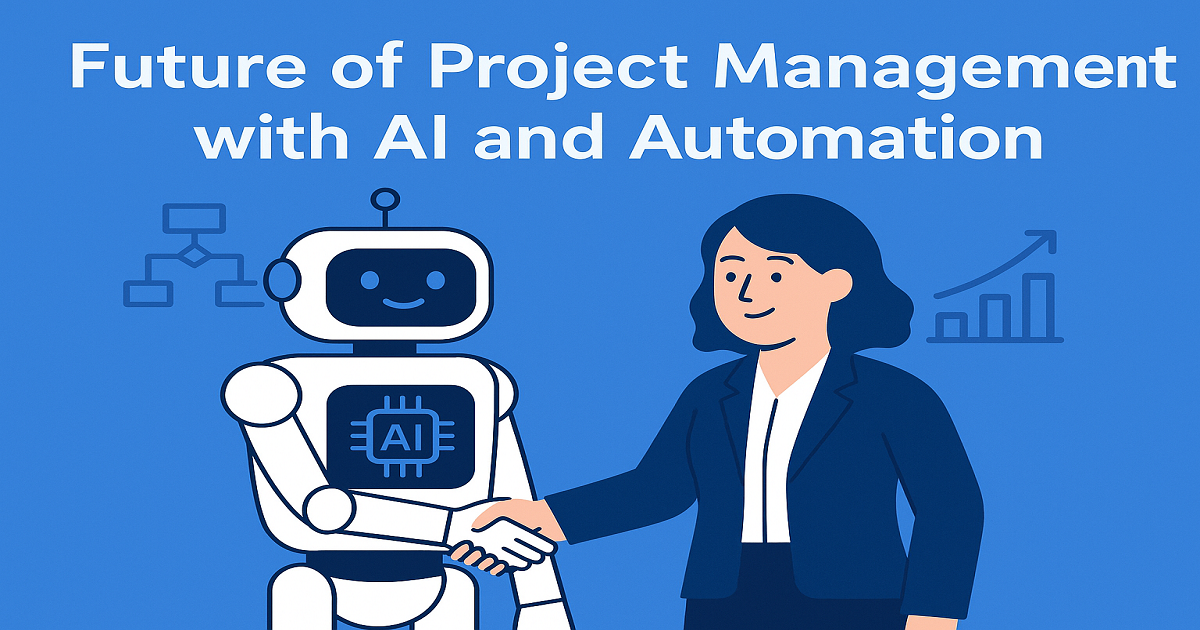
Project management is undergoing transformational changes due to the incorporation technology such as AI as well as automation technology. With the rapid growth of digital technology the use of AI-powered tools and automated processes are changing the way the projects will be planned, carried out tracked, delivered, and monitored. Project management’s future will bring incredible efficiency, precision and speed, allowing teams and businesses to deliver higher-quality results using lesser time and effort.
In this article, we examine how we can improve the future of project management using AI as well as automation by highlighting the most important technology, benefits, emerging trends and the challenges to be faced. The project managers, the stakeholders and companies will gain valuable knowledge on how to adapt to this changing environment using automation and AI to boost the efficiency of projects.
Why AI and Automation Are Game-Changers for Project Management
The project management has historically involved manual planning schedule, communication, and reporting. The processes are often long-lasting, susceptible to error by humans, and inefficient, particularly as projects increase in complexity and size. AI and automation technology addresses these issues through automation of routine tasks, improving decision-making through data-driven insight, and enhancing the coordination of workflows.
Some of the motives AI or automation will be vital in the near future of managing projects. These include:
- Improved Efficiency: Automated workflows can eliminate routine tasks like schedule updates, status updates or resource management, allowing project managers to concentrate on leadership strategies.
- Data-driven decisions: AI analyzes vast quantities of project information to offer analytic predictive analysis, risk assessment and performance analysis.
- Better Accuracy: Reduces human errors in tracking budgets as well as task assignments and estimates of timelines.
- Scalability: lets you manage large portfolios of projects while maintaining consistency in quality and tracking.
- Enhanced collaboration: AI-powered assistants and chatbots enable real-time communication between the teams as well as time zones.
- Flexibility: It allows for agile project management through quickly making adjustments to plans based on current information.
Key AI and Automation Technologies Shaping Project Management
1. AI-Powered Predictive Analytics
The most powerful AI apps is predictive analysis, that can forecast project outcomes based upon the past and current data as well as real-time variables. Project managers are able to identify uncertainties, estimate the timeframes of projects more precisely and detect possible bottlenecks prior to them affecting the project’s progress.
- Predictive algorithms look at the use of resources, past results of projects, and external circumstances.
- Early alerts from AI aid in prioritizing tasks and effectively allocate resources for contingency.
2. Intelligent Automation of Routine Tasks
Automated bots take care of repetitive tasks like sending reminders, producing status reports, updating schedules and logging the task’s complete. This decreases administrative costs and reduces the time spent on manual follow-ups.
- Workflow automation platforms such as Zapier, N8n, and Microsoft Power Automate integrate diverse tools for managing projects.
- Alerts that are automated and escalated increase the speed of response and accountability.
3. Natural Language Processing (NLP) and Chatbots
NLP helps AI comprehend and create human language, which allows virtual assistants for projects to respond to questions, take notes of meetings and send immediate updates to the stakeholders through chat interfaces.
- Chatbots are able to handle FAQs for projects and free managers from repetitive questions.
- Virtual assistants organize appointments, delegate tasks and report on the progress.
4. Machine Learning for Resource Optimization
Machine learning models evaluate patterns of workload in projects to improve the distribution of resources. The resources–whether equipment, personnel or budget–are allocated precisely when and where they can be of the greatest value.
- Adaptive scheduling can be improved using constantly learning preferences and abilities.
- AI manages workloads in a way that prevents burning out and boost team productivity.
5. AI-Enhanced Risk Management
AI analyzes risk scenarios that are complex beyond the human cognitive capabilities through the integration of multiple sources of information. It can identify hidden risks between the market, suppliers and compliance concerns.
- The risk dashboards powered with AI give you dynamic recommendations regarding mitigation techniques.
- Continuous monitoring helps to adjust risk profiles as projects develop.
Benefits of AI and Automation in Project Management
The integration of AI and automation can bring tangible benefits to every phases of the project’s lifecycle:
- Planning: Rapid formulation of solid plans and project charters through data synthesizing as well scenario modeling.
- Scheduling: Scheduling dynamically that adjusts to delays or shifts in real time.
- Execution: Automated task sequencing as well as stakeholder notification and tracking progress.
- Monitoring: Continuous data capture from many sources, providing real-time dashboards as well as KPI analysis.
- Closing: Automated generation of documentation and lesson-learned reports to improve the future.
The improvements are:
- Faster delivery of projects.
- Lower operating expenses.
- Higher success rate of projects.
- Stakeholder satisfaction is improved.
- Improved team morale because of less administrative burden.
Emerging Trends in AI-Driven Project Management
Hybrid Project Management
The future will combine traditional waterfall methods with the agility of AI-enabled flexible models. AI tools can improve workflows across various methodologies, determining the most effective strategy for each stage of the project.
AI and Automation Governance
As AI takes autonomous decisions the governance policies and guidelines for ethical conduct are constantly evolving to provide human oversight, fairness and accountability.
Integration with IoT and Big Data
IoT devices collecting real-time project environment data (e.g., construction site sensors) feed AI-powered project dashboards, enabling proactive management.
Augmented Reality (AR) and Virtual Reality (VR)
Augmented reality and VR enhances the visualization of AI insights, specifically for construction and industrial projects.
Challenges and Considerations
The direction of the future for project management using AI and automation looks promising, there are a few issues that require being addressed.
- Change Management: The adoption of AI requires cultural changes in training, as well as trust-building within teams.
- Quality of Data: The effectiveness of AI is contingent upon the accuracy and quantity of data input.
- Safety and Privacy: Secure project data within AI systems is vital.
- cost of implementation: Smaller companies might face budgetary constraints when adopting the latest AI tools.
- Human Element: AI complements but is not a substitute for human intelligence, creativity and leadership.
Preparing for the AI-Driven Project Management Future
Organizations and project managers are able to take proactive steps to succeed in the ever-changing world:
- Keep up-to-date Keep up to date with AI and automation trends that pertain to managing projects.
- Learn Continuously Gain knowledge about AI tools as well as data analytics and hybrid methods.
- Pilot AI Tools Start small by implementing AI pilots for automation to show the value of AI and to refine processes.
- Encourage Collaboration Promote the openness of communication among IT team members, project teams and all other parties.
- The focus is on ethics Create policies that ensure that the ethical AI usage that is in line with the organization’s values.
FAQs: Future of Project Management using AI and Automation
Q1: When do you expect to see AI and automation become a norm within project management?
Many organizations are using AI-powered software today and widespread standardization is expected in the next three to five years as technology improves and the barriers fall.
Q2: Can AI be able to replace the project manager?
No. AI will assist project managers in the way of handling routine tasks and providing insight but leadership, critical thinking and human judgement remain indispensible.
Q3: Which kinds of projects would benefit the greatly from the use of AI?
Complex, large-scale projects that undergo frequent modifications like IT development, construction and manufacturing gain a lot from AI’s predictive capabilities as well as automation.
Q4: When can project managers begin by using AI instruments?
Start by adding AI-powered scheduling, report chatbots, or other assistants in the existing software for managing projects. Training and demonstrations from vendors will help to encourage early adoption.
Q5: Are there any dangers in using AI in the field of project management?
Possible risks include over-reliance that could result in the loss of crucial capabilities, biases within AI models, as well as privacy concerns with regards to data. A careful use of AI with oversight from humans minimizes the risks.
Q6: Which competencies do project managers need to develop to prepare for Artificial Intelligence’s future?
Learning to be data-literate proficiency, fluency with technology, ability to manage change and maintaining a strong interpersonal communication skills will help project managers to succeed.
Conclusion
Project management’s future using AI and automated processes is set to change the way projects are executed more efficiently, with greater intelligence and with greater flexibility. Incorporating AI technologies will help project managers and companies to manage complexity, mitigate risks more effectively, and achieve greater efficiency while allowing human beings to concentrate on problems-solving, and leading.
Being ahead of the curve requires attention of upskilling and the use of AI tools that align with the goals of the project and the culture of the organization. Through this project professionals can uncover new opportunities to redefine the way they work in an the increasingly digital age.
Start exploring the possibilities of AI-driven project management today and take part in the future shaping the outcome of the projects of the future.